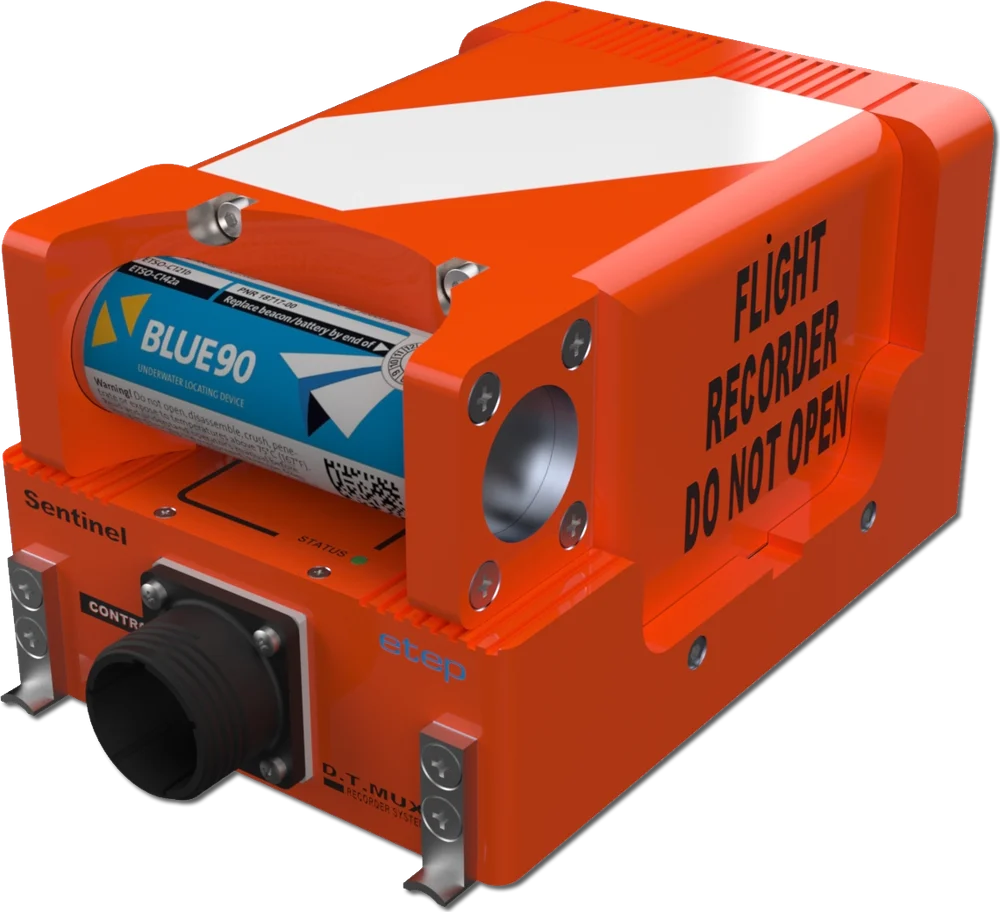
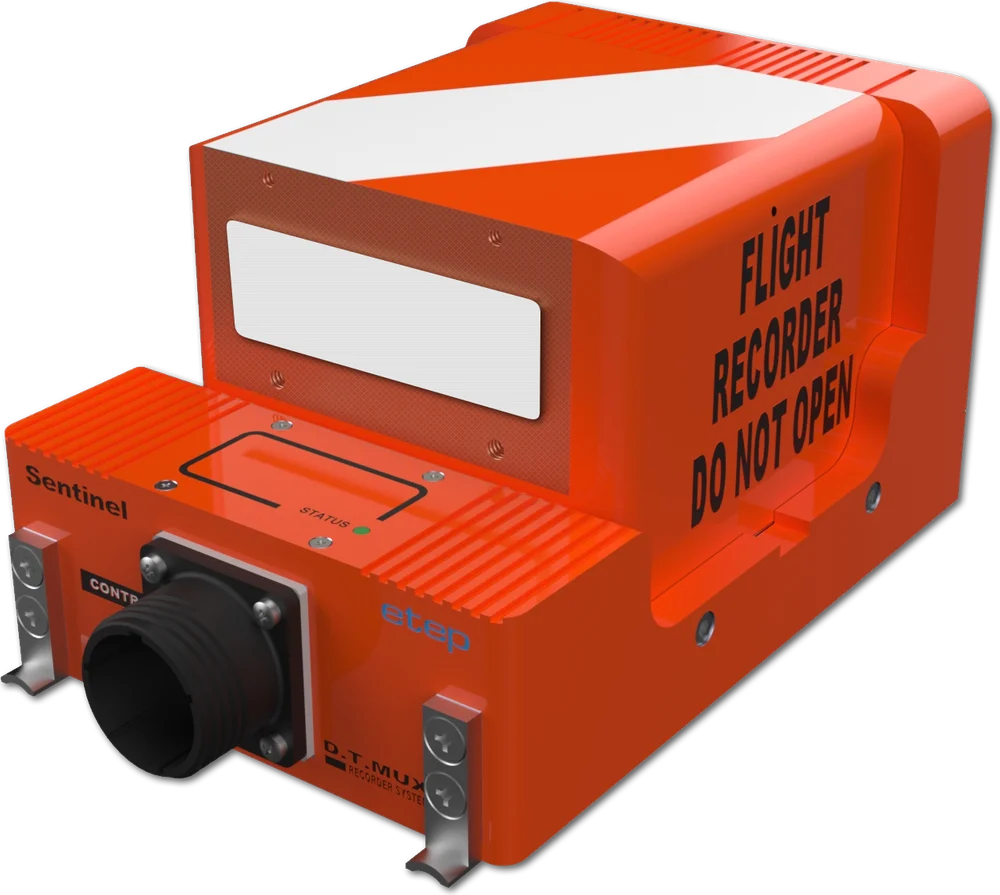
Sentinel CSMU
Applications Crash protection
A compact, ultra-lightweight crash-survivable memory unit that protects flight data to EUROCAE ED-155 or ED-112A so it can be recovered after a serious accident.
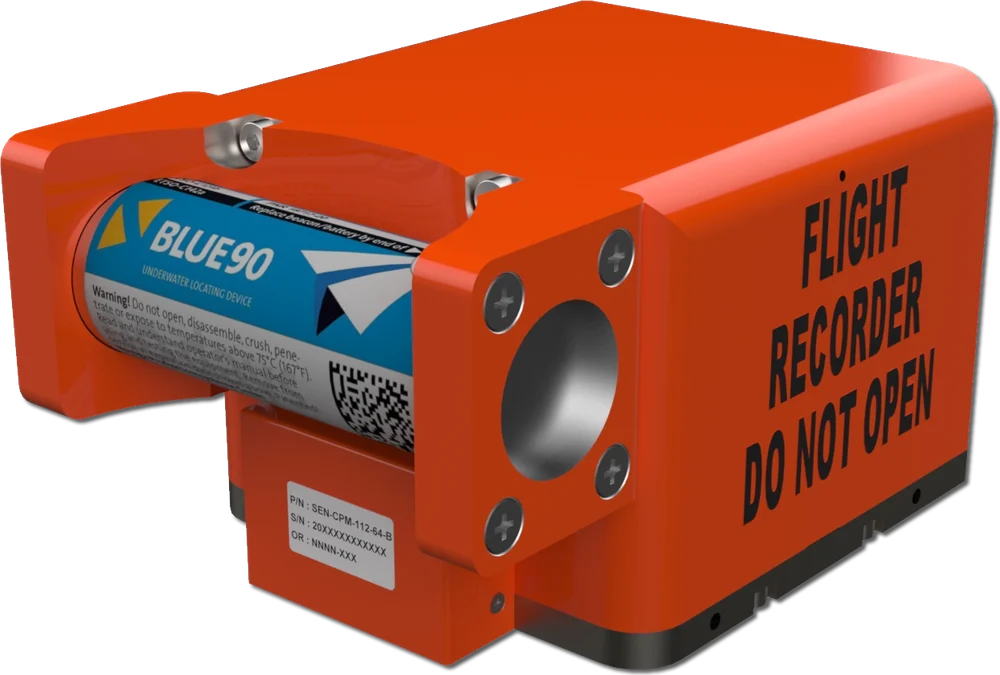
The Sentinel Crash Survivable Memory Unit (CSMU) — a titanium crash-protected memory module meeting EUROCAE ED-155 or ED-112A requirements, enabling data recovery after a serious accident. Compact and ultra-lightweight, from 16 to 128 GB.
The Sentinel CSMU is the crash-protected memory core that hosts the recorded data at the heart of ETEP's Sentinel black-box line. Rather than a fixed recorder, it is delivered as a memory module intended for integration into a customer's own recording or acquisition system and configured to the mission's capacity, weight and survivability targets.
It is offered in two variants sharing a common design: the lighter CSMU-ED155 for cockpit voice and lightweight data-recording duties, and the more rugged CSMU-ED112A that adds the survivability and 90-day underwater locator beacon required for full flight-recorder certification.
- ED-112A / ED-155 crash protection
- 16 / 32 / 64 / 128 GB
- 3 400 g impact · 5 000 lb crush (ED-112A)
- Titanium enclosure · 1 100 °C fire · 30-day immersion
- MTBF > 1 million hours
- Ultra-lightweight (2–2.5 kg)
- Data encryption option
- 90-day ULB (TSO-C121b) — standard on ED-112A
Manuals, returns and product notices: Support & documentation →
 Compatible software D.T.MUX Viewer Replay, decode & visualize your recordings
 MAIN ADVANTAGES
- Meets EUROCAE ED-155 or ED-112A crash-survivability requirements
- Titanium enclosure in bright orange with reflective white strip
- Survives 3 400 g impact, 5 000 lb static crush and 1 100 °C high-temperature fire for 1 hour (ED-112A)
- 30-day sea-water immersion and 20,000 ft deep-sea pressure survivability (ED-112A)
- Compact and ultra-lightweight, 2 to 2.5 kg
- Selectable capacity from 16 to 128 GB (iSLC, 200,000 erase cycles)
- Optional data encryption
- 90-day underwater locator beacon (TSO-C121b / ETSO-C142a certified, 6-year battery) — standard on ED-112A, optional on ED-155
- Configurable for integration into customer applications
Crash-survivable memory to ED-155 / ED-112A
The Sentinel CSMU packages solid-state memory inside a protective titanium enclosure engineered to keep recorded data intact through the full crash sequence. The ED-112A version is rated for 3 400 g / 6.5 ms impact, 500 lb pin penetration, 5 000 lb static crush on all axes, 260 °C low-temperature fire for 10 hours, 1 100 °C high-temperature fire for 1 hour, 30-day sea-water immersion and 24 hours at 20,000 ft deep-sea pressure; the lighter ED-155 version covers 1 000 g impact, 1 100 °C fire for 15-30 minutes and 3-day immersion. An optional data-encryption capability protects the recovered data against unauthorised access.
Built to survive the crash sequence
- Temperature
- -40 … +85 °C
- Vibration
- 2.09 g RMS (10 Hz–2 kHz)
- Shock
- 1 500 g / 0.5 ms
- Acceleration
- 20 g
- MTBF
- > 1 000 000 h
- Interface
- Micro SATA (5 V)
- Power
- 5 W (ED-112A) / 3 W (ED-155)
- Weight
- ≈ 2 kg (2.5 kg with ULB)
- Dimensions
- 109 × 109 × 86 mm
- Mounting
- 4 × M4 screws
// CONFIGURATOR
Build your Sentinel CSMU.
Compose your crash-survivable memory unit field by field and watch the part number build itself — exactly as in the datasheet. Then send your configuration to our team for a quote.