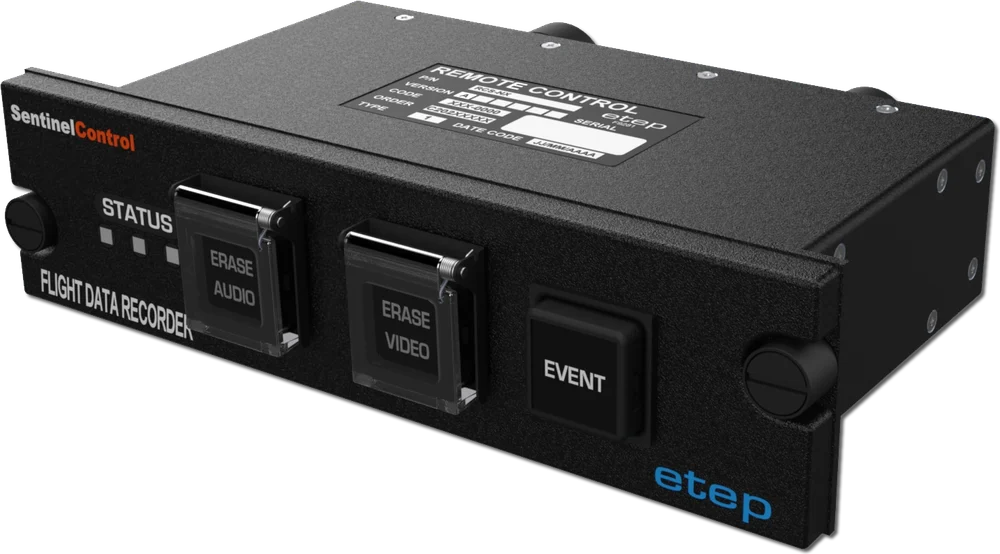
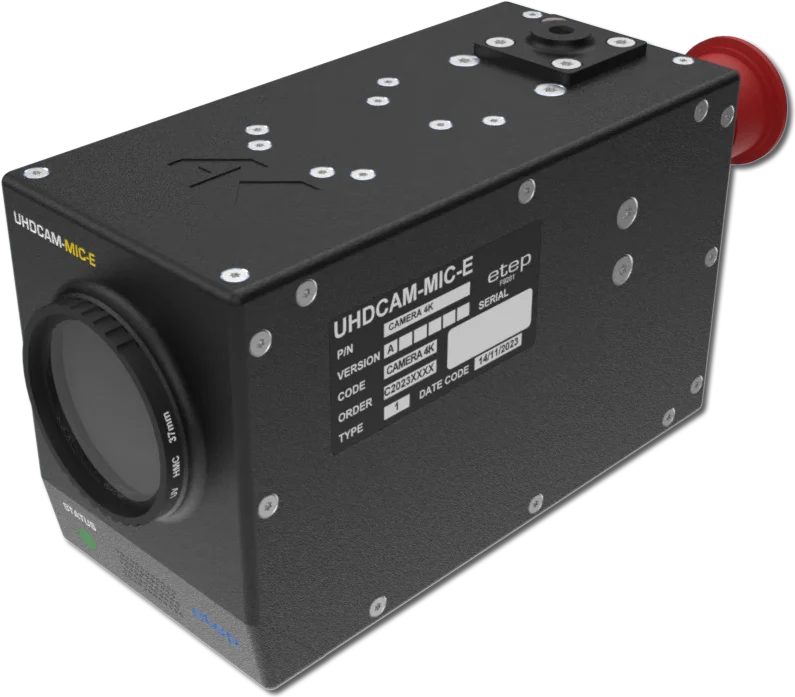
3 400 g
Impact shock
half-sine, 6.5 ms
Deceleration against a rigid structure or the ground
Applications Crash protection
The smallest ED-112A crash-survivable recorder — flight data, cockpit audio and image/video in one lightweight unit, qualified to DO-160G and MIL-STD-810G.
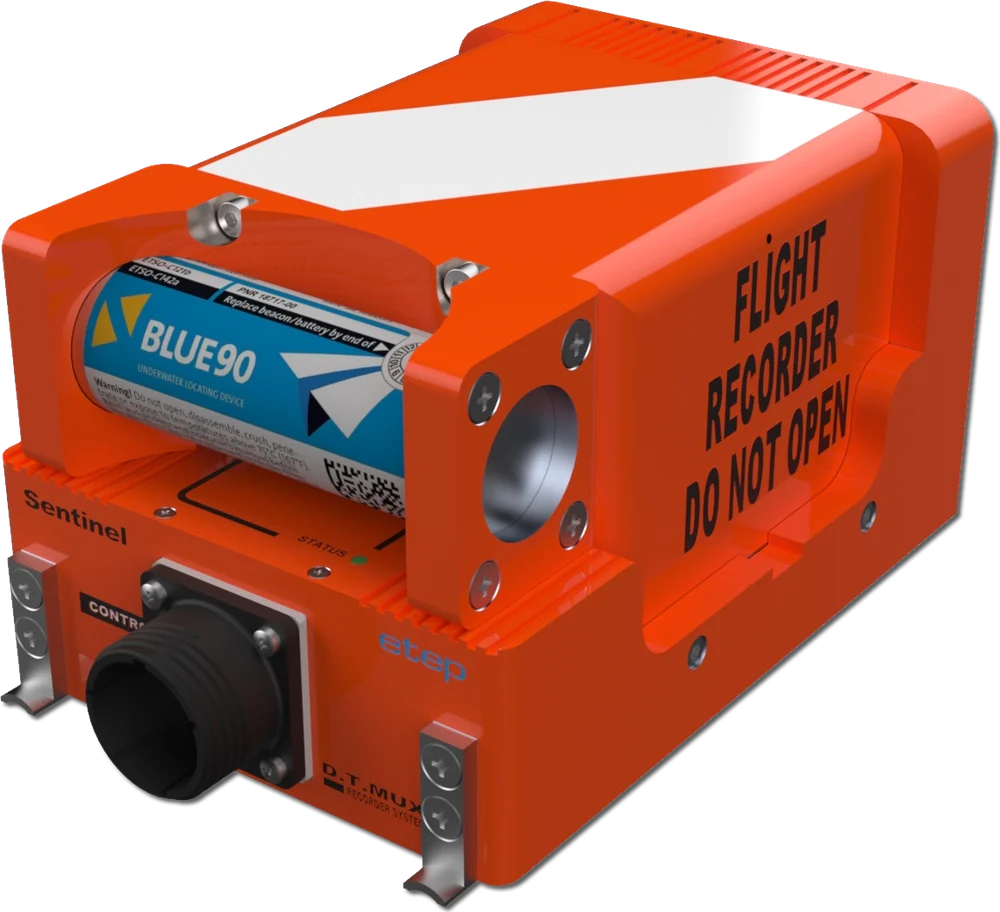
A lightweight, fully integrated crash-protected airborne data recorder (FDR / CVR / AIR) that also acts as a data-acquisition unit (DAU). Records flight data, cockpit audio and Full HD 1080p or Ultra HD 4K video (1–30 fps) for helicopters, fixed-wing aircraft and UAVs — qualified to DO-160G and MIL-STD-810G.
Purpose-built for flight-test campaigns, crash/impact testing and military or general aviation — on helicopters, fixed-wing aircraft and UAVs — the Sentinel ED-112 folds FDR, CVR and AIR functions into a single crash-protected box that also acts as its own data-acquisition unit (DAU). This delivers a powerful recording solution at minimum cost, weight and size for platforms where a full multi-box installation would be impractical.
The recorder captures serial-bus, analog or internal-sensor data (3-axis gyro, G-force, pressure) alongside four audio channels and Full HD 1080p or Ultra HD 4K video at 1-30 fps, each function operating independently or in combination, recorded in IRIG 106 Chapter 10 or D.T.MUX format. Time synchronisation is available via GPS, IRIG-B or PTP v2; an internal ultracapacitor rides through supply interruptions of up to 2 seconds.
Manuals, returns and product notices: Support & documentation → · Compare the recorders →
 Compatible software D.T.MUX Viewer Replay, decode & visualize your recordings
// LOOP RECORDING
Used as an FDR or CVR, a crash-protected recorder writes in a loop. Once its memory is full it keeps recording, each new second replacing the oldest one, so what it holds after an accident is always the end of the story: the most recent data, down to the last seconds.
Schematic view of the principle, not to scale: one turn of the ring stands for the whole memory. FDR, flight-test and mission recorders compared →
The Sentinel is engineered to the EUROCAE ED-112A crash-survival standard, protecting recorded data, audio and image through impact, fire and immersion. ETEP presents it as the smallest recorder to cover this requirement while still increasing recording capacity. An optional underwater locator beacon (ULB) aids post-incident recovery.
// CRASH PROTECTION · ED-112A
What EUROCAE ED-112A demands of the crash-protected memory, test by test.
3 400 g
half-sine, 6.5 ms
Deceleration against a rigid structure or the ground
227 kg
dropped from 3 m onto a 6.35 mm steel pin
A structural member driven into the unit
22.25 kN
5 000 lbf for 5 min, on each axis
The wreckage settling onto the recorder
1 100 °C
for 60 min, over the whole module
A kerosene pool fire at the crash site
260 °C
for 10 h
The smouldering fire that follows the flames
6 096 m
sea water for 30 days
Loss at sea, with recovery weeks later
Levels required by ED-112A, plus immersion in aircraft fluids: fuels, oils, hydraulic and de-icing fluids. ED-112A and ED-155 in detail →
// UNDERWATER LOCATOR BEACON · ULB
Surviving is useless if the recorder is never recovered. Fixed to the crash-protected module, the beacon starts on contact with water and sends out an acoustic signal that a search vessel can follow with a towed hydrophone.
Schematic view, not to scale. Colour, lettering, beacon: how a recorder is found →
// CONFIGURATOR
Compose your crash-protected recorder field by field and watch the part number build itself — exactly as in the datasheet. Then send your configuration to our team for a quote.
Type at least two letters. Enter opens the first result.