Hundreds of channels, spread out
A bench, a stand or a track can carry hundreds of sensors over tens of metres, sometimes several kilometres. Long analog runs pick up noise and lose bandwidth: the acquisition has to move next to the sensors.
Not every test flies. Engine and structure benches, aircraft ground tests, propulsion stands and instrumented vehicles need what a flight test needs: many channels, one time base, a recording you can trust and a live view. The NanoX was built to fly, which is exactly why it holds up on the ground.
scroll
THE PROBLEM
Ground tests are often harder on instrumentation than flight. Three things go wrong most often.
A bench, a stand or a track can carry hundreds of sensors over tens of metres, sometimes several kilometres. Long analog runs pick up noise and lose bandwidth: the acquisition has to move next to the sensors.
As soon as the acquisition is distributed, comparing two channels means comparing two clocks. Without one shared time base, a transient seen in two places cannot be correlated.
Heat next to an engine, vibration on a stand, shocks in a vehicle, dust and long cables: laboratory equipment does not survive the conditions that make these tests worth running.
THE ANSWER
The NanoX acquisition unit, qualified for flight, put to work on the ground.
Strain gauges, thermocouples and RTDs, ICP vibration sensors, charge amplifiers for high-temperature engine sensors, pressure, counters for RPM and flow, CAN for vehicles, and analog outputs to drive a bench: up to sixteen modules per unit, swapped in seconds.
Several NanoX units placed next to the sensors, linked over Ethernet to a master unit that records and streams in IRIG 106 Chapter 10, IENA or D.T.MUX, with one time reference shared by all of them.
D.T.MUX Viewer displays the streams live in the control room and replays the recording afterwards, on the same dashboards. LAB D.T.MUX configures every unit.
Qualified to DO-160G and MIL-STD-810G and operating from −40 to +71 °C, the NanoX takes the heat, the vibration and the shocks. Battery modules give an hour of autonomy each, up to three, for vehicles and stands without power.
RELATED PRODUCTS
The acquisition unit, the network that links several of them, and the station that receives when the test also transmits.
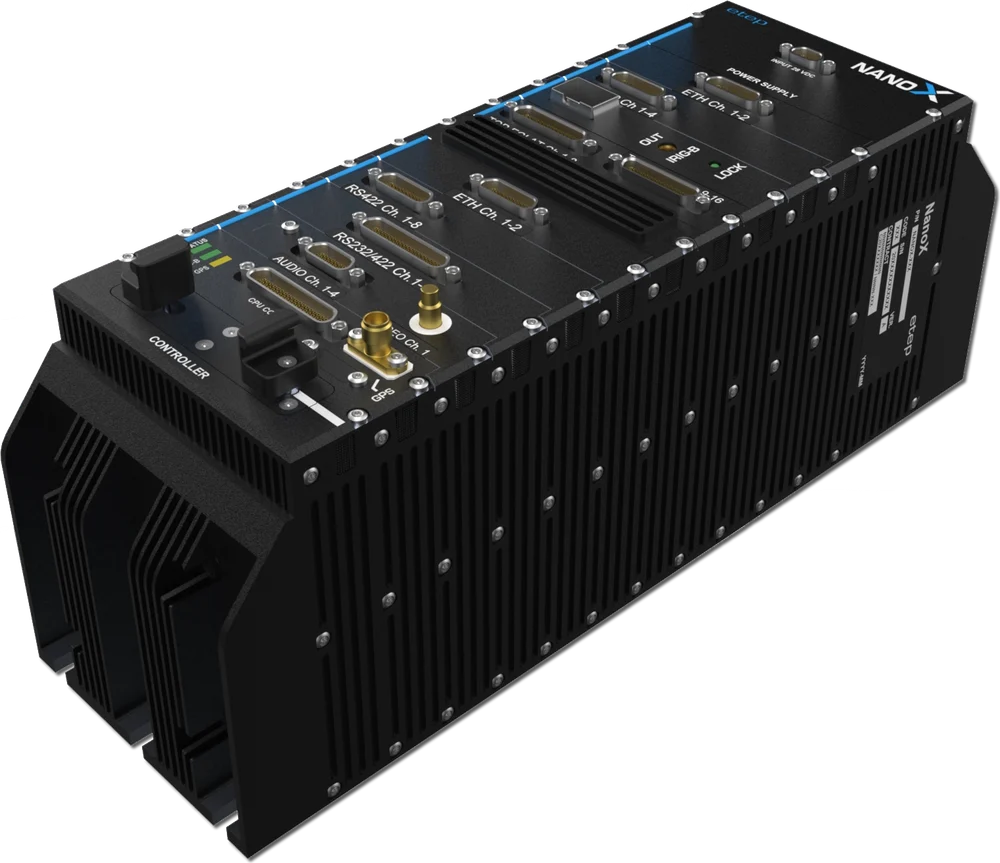
High-speed 1 Gbps acquisition / recording / replay / transmit.
VIEW MORE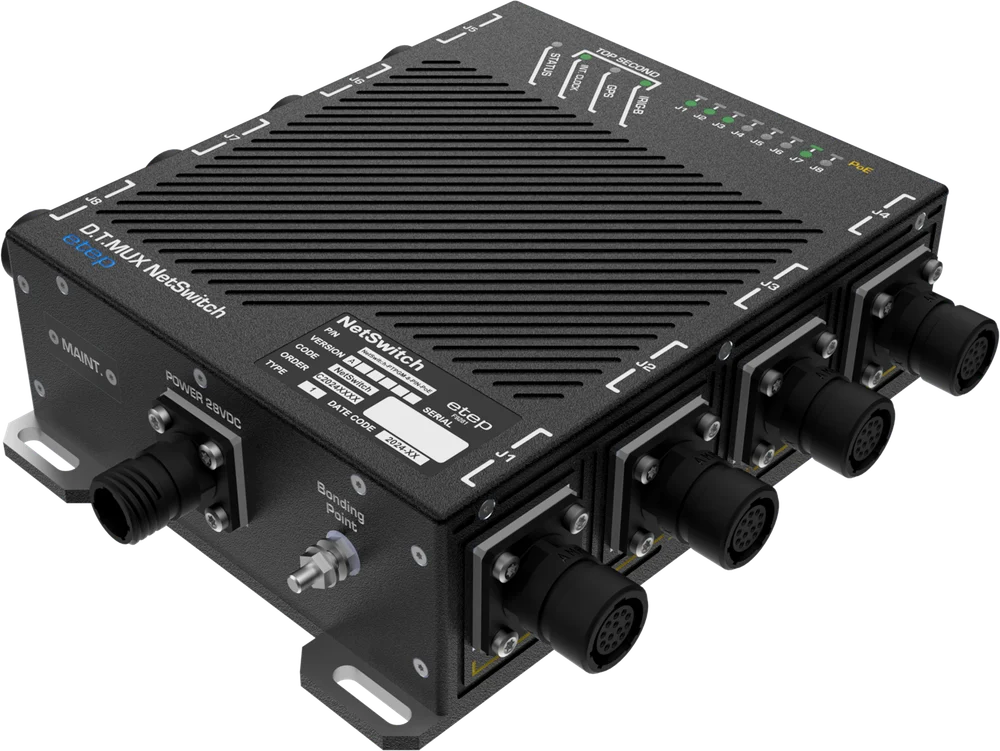
8–24-port GbE managed switch, IEEE 1588 PTP, PoE+ option.
VIEW MORE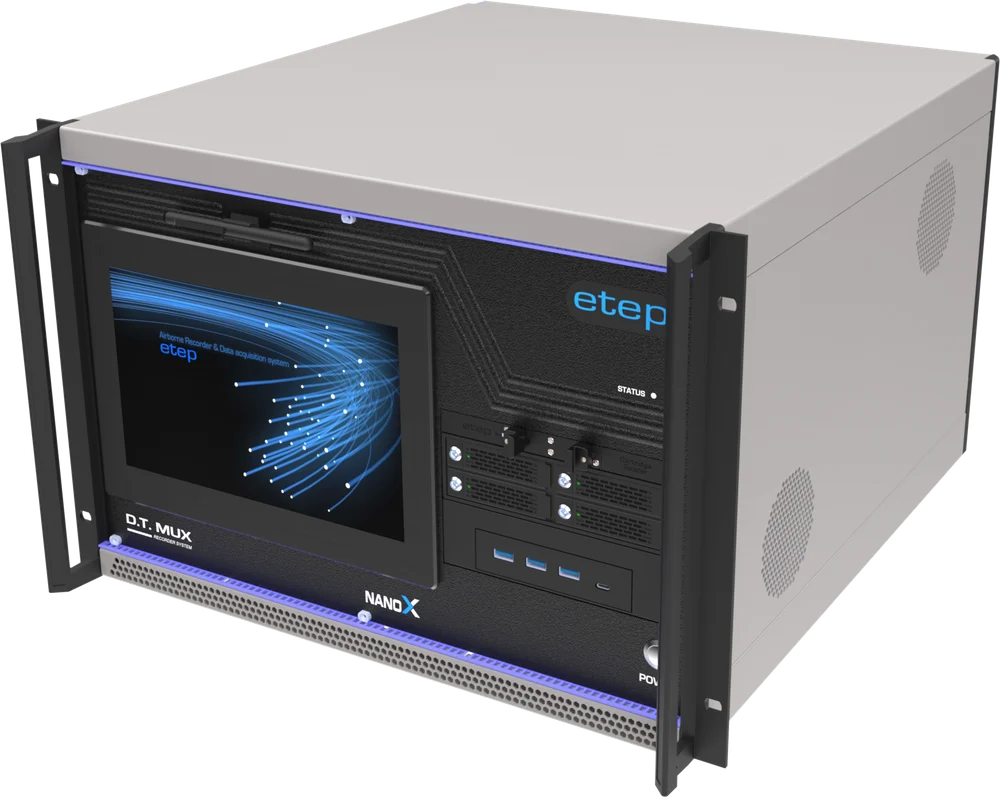
Telemetry receiver, recording, real-time viewing, replay & post-processing.
VIEW MORESOFTWARE
CASE STUDY
As a rule, we do not name our customers. The configurations are real; the identities are not.
GO FURTHER
The question looks like an architecture debate. It is mostly geometry: how far your sensors are from each other, and who owns the mass of the harness.
Design & architectureEvery other measurement can be repeated. A timing error cannot: it is discovered months later, during analysis, and it invalidates every comparison that was built on it.
Acquisition & recordingMost defects in a measurement chain announce themselves. Aliasing does not: it produces a clean, plausible, entirely fictitious signal, and it is the only error in the chain that cannot be repaired afterwards.
Design & architectureFour budgets have to close at once — bit rate, storage, telemetry and mass — and they are coupled. Here is the arithmetic, done all the way through on a real-shaped installation.
FREQUENTLY ASKED
Often the opposite. Ground tests can be harsher than flight — next to an engine, on a vibrating stand, in a vehicle. And using the same unit on the bench and on the aircraft keeps one configuration, one format and one software from the first ground run to the first flight.
One of our installations spreads six units along a test track several kilometres long, sampling up to a megahertz on one time base. The distance is set by the network and the time distribution, which we design with you.
Yes. The NanoX records internally and streams in real time in Chapter 10, IENA or D.T.MUX format: the control room watches live while the full recording stays safe in the unit.
OTHER APPLICATIONS
Send us the channel list, the rates and the distances. We come back with an architecture and the modules that fit it.
Talk to an engineer →Type at least two letters. Enter opens the first result.