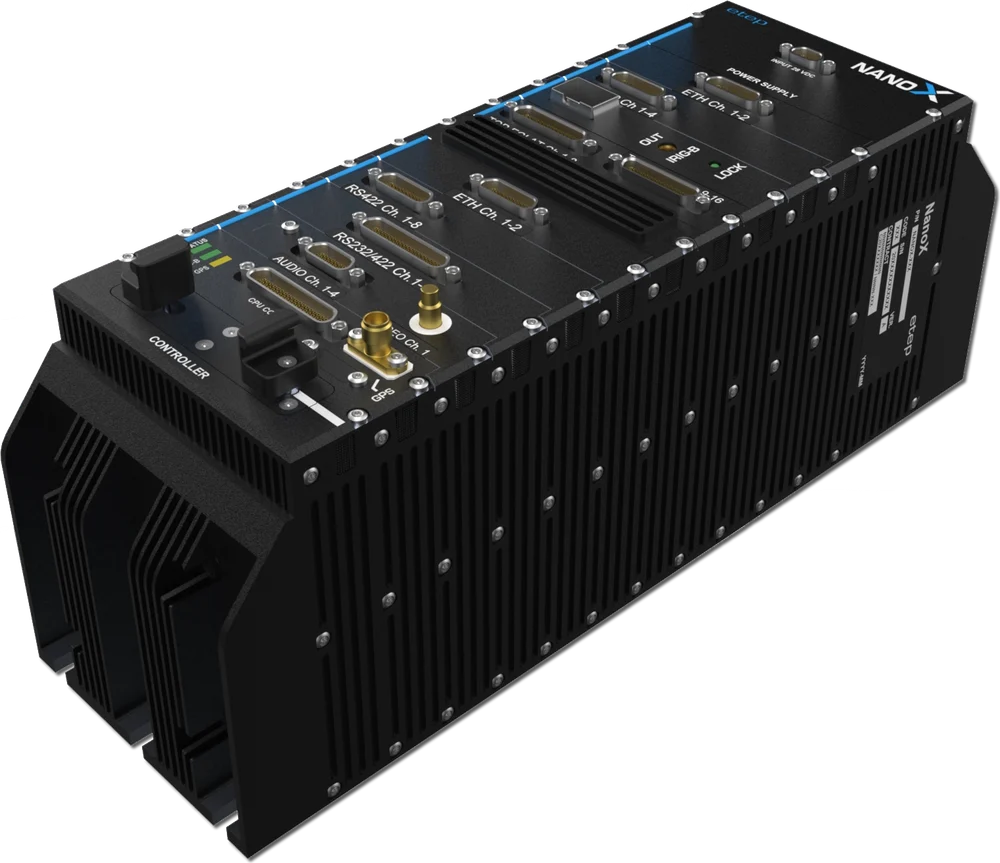
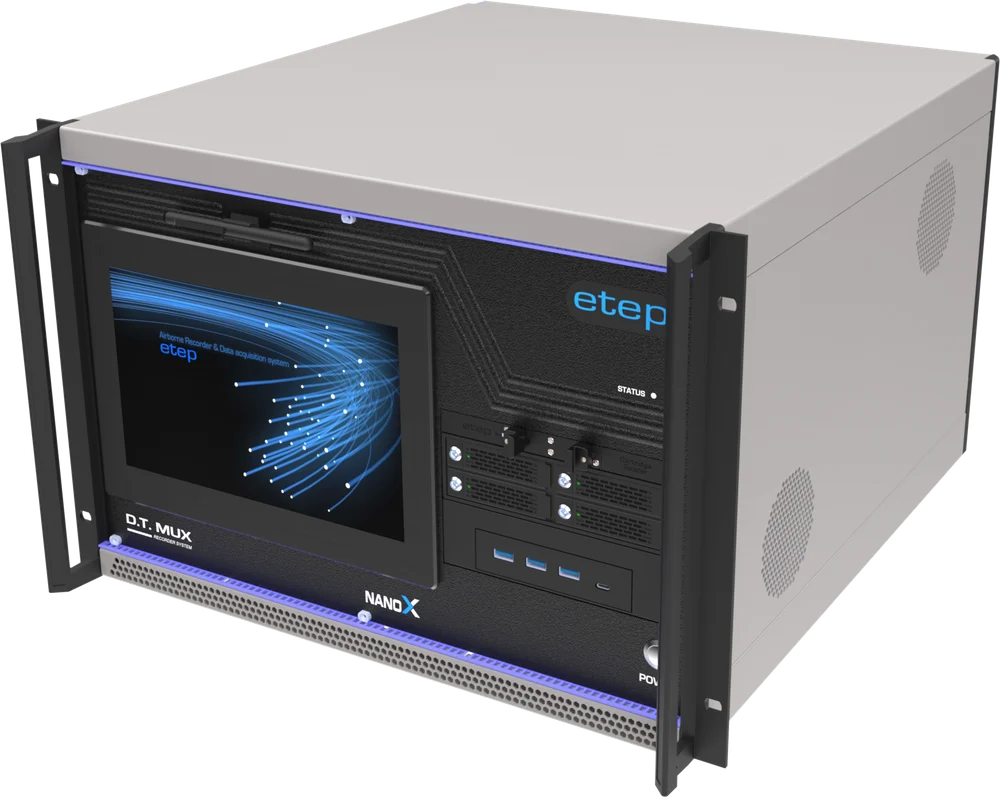
D.T.MUX TX-MOD
Applications Flight testGround telemetry
A user-programmable airborne telemetry transmitter delivering 1 to 20 W across S, L and C-band, with SOQPSK and LDPC coding for reliable ground-link performance.
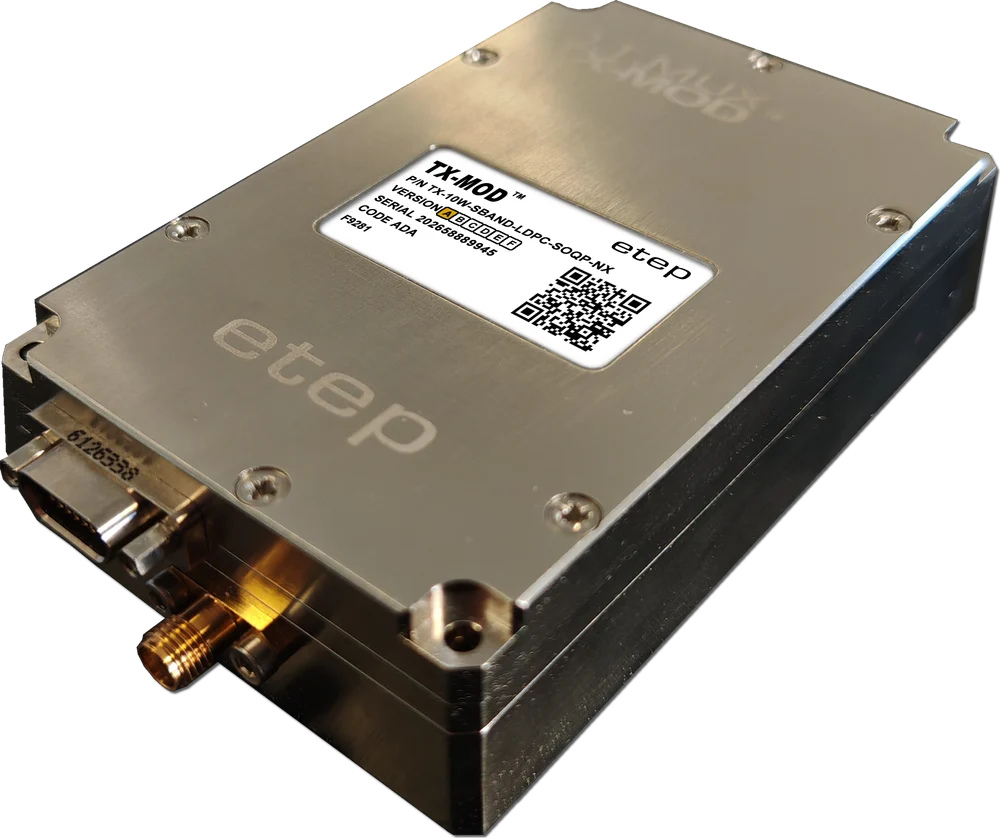
On-board digital telemetry transmitter module — standalone or for the NanoX system — that sends airborne test data to ground stations with fully user-programmable frequency and modulation. 1 to 20 W across S/L/C-band with LDPC and SOQPSK, qualified for pods and fighter, surveillance and helicopter operations.
The TX-MOD operates either as a standalone airborne transmitter or as an integrated module of the D.T.MUX NanoX system, sending flight-test data from the test target to ground stations. Frequency and modulation are fully user-programmable, and configuration settings are held in nonvolatile solid-state memory so the unit retains its setup between missions.
It accepts data and clock on RS422 lines at rates up to 40 Mbps and is monitored over a separate RS232 link, making it straightforward to embed in fighter, surveillance and helicopter installations as well as instrumentation pods.
- 1–20 W RF output (43 dBm ±1 dB)
- S-band 2200–2400 / L-band 1400–1600 / C-band 5090–5250 MHz
- Optional extended bands: S 2185–2485 / C 4400–4900 MHz
- 1–20 Mbps PCM/FM · 1–40 Mbps SOQPSK (RS422) · 100 kbps option
- PCM-FM (ARTM Tier 0) & SOQPSK-TG (ARTM Tier 1)
- LDPC coding (rates 1/2, 2/3, 4/5)
- Frequency stability ±2.5 ppm over temperature
- IRIG 106-96 / -15 / -17 compliant
- RS232 monitoring (≤ 115 200 baud)
Manuals, returns and product notices: Support & documentation →
 Compatible software D.T.MUX Viewer Replay, decode & visualize your recordings
MAIN ADVANTAGES
- Fully user-programmable frequency and modulation, stored in nonvolatile solid-state memory
- Standard bands: S 2200-2400 MHz, L 1400-1600 MHz, C 5090-5250 MHz - extended S (2185-2485 MHz) and C (4400-4900 MHz) available as options
- PCM-FM (ARTM Tier 0) from 1 to 20 Mbps and SOQPSK-TG (ARTM Tier 1) from 1 to 40 Mbps, with an optional 100 kbps low rate
- Optional LDPC coding for improved link robustness (blocks 1024/4096, rates 1/2, 2/3, 4/5)
- No performance degradation with open- or short-circuit load mismatch
- Low spurious outputs (typ. -60 dBc) and tight frequency stability over temperature
- Space Time Coding (STC) option: 2x5 W with dual antennas per IRIG 106-15 Appendix S
- Qualified for fighter, surveillance, helicopter, flight-test aircraft and pod installations
// RF SPECTRUM
Same band, more data.
PCM/FM and SOQPSK-TG side by side, on the same frequency scale. SOQPSK-TG packs its power into a narrower band, so the same band carries more data. The TX-MOD offers both.
≈ 1.16 × Rb 99 % occupied bandwidth
≈ 1.16 × Rb same band as PCM/FM
- Same bit rate: SOQPSK-TG occupies ≈ 0.78 × Rb, PCM/FM ≈ 1.16 × Rb.
- Same band: SOQPSK-TG fills it at ≈ 1.5 × Rb, about 50 % more data.
- PCM/FM · ARTM Tier 0
- 1–20 Mbps
- Standard, no option needed
- SOQPSK-TG · ARTM Tier 1
- 1–40 Mbps
- SOQP option, also included with LDPC
- Spectral occupancy
- IRIG 106-17 Ch. 2
- Spectral mask, Tier 0 and Tier 1
Illustrative spectra: the shapes are schematic, not measurements of the TX-MOD. Rb is the bit rate; the occupied bandwidth holds 99 % of the transmitted power (typical values). PCM telemetry: frames, sync and link budget →
SOQPSK, LDPC and Space Time Coding
The TX-MOD supports ARTM Tier 1 SOQPSK-TG modulation for spectrally efficient transmission and offers an LDPC coding option (code blocks 1024 and 4096 at rates 1/2, 2/3 and 4/5, per IRIG 106-15 Appendix R) to strengthen the ground link. A Space Time Coding (STC) option adds a 2x5 W dual-antenna configuration per IRIG 106-15 Appendix S to mitigate multipath and antenna-shadowing dropouts. All modes comply with IRIG 106 telemetry standards.
Frequency stability and RF integrity
- Frequency stability
- ±2.5 ppm (operating) · ±7.5 ppm (5 yr, all clauses)
- VSWR
- 1.5 : 1
- Load mismatch
- Open / short-circuit tolerant
// CONFIGURATOR
Build your TX-MOD.
The onboard S/L/C-band transmitter, from 5 to 20 W. Pick the RF power, frequency band and coding option and the reference builds itself — exactly as in the datasheet. Send your configuration to our team for a quote.
Requirements beyond these options — another band, power or interface — are handled case by case: talk to our team.