
History & heritage
From the sea to the aircraft: how ETEP began
ETEP started in 1979 in Toulon, with an electronics engineer, Jean-Patrick Caille, and with the sea: hydrophone acquisition units, sonar recording and computerised test benches for the French Navy. Alongside, a second field taught it to record the faint signals of the human body. Everything ETEP builds today — recorders that fly, survive crashes and keep their data — grew out of those two schools.
An engineer and the sea
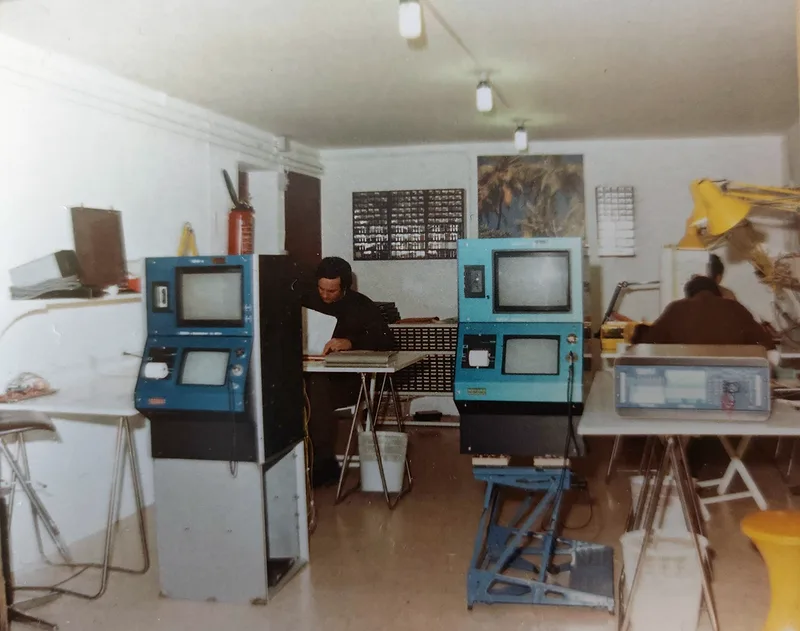
Jean-Patrick Caille was an electronics engineer. He founded ETEP in 1979 in Toulon, the French Navy's main port, and worked for the Navy from the very beginning. The company stayed in Toulon until 2006, then moved to Cuers, about twenty kilometres away, where it still is. The sea shaped its first instruments: electronics that had to listen, measure and record at sea, far from any laboratory.
The first instruments, for the Navy
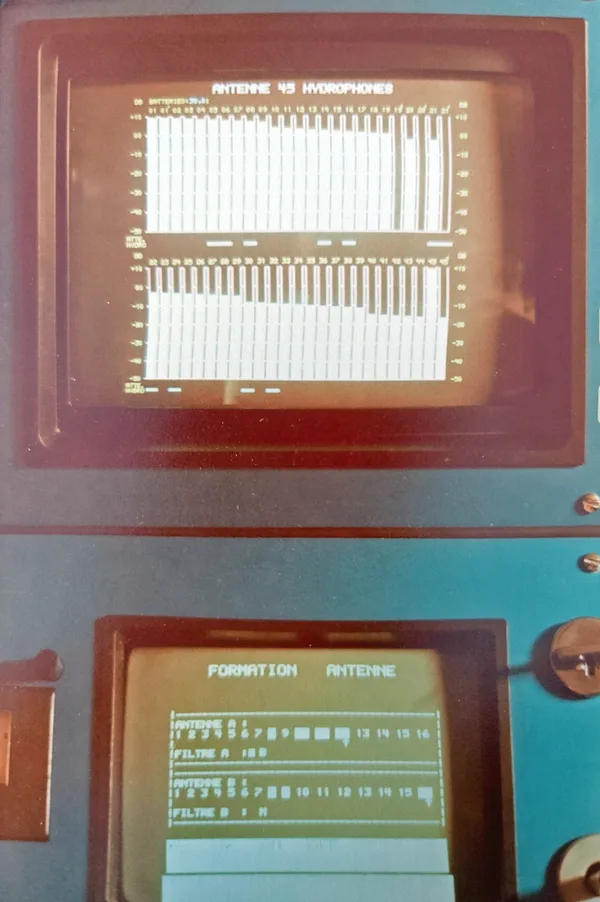
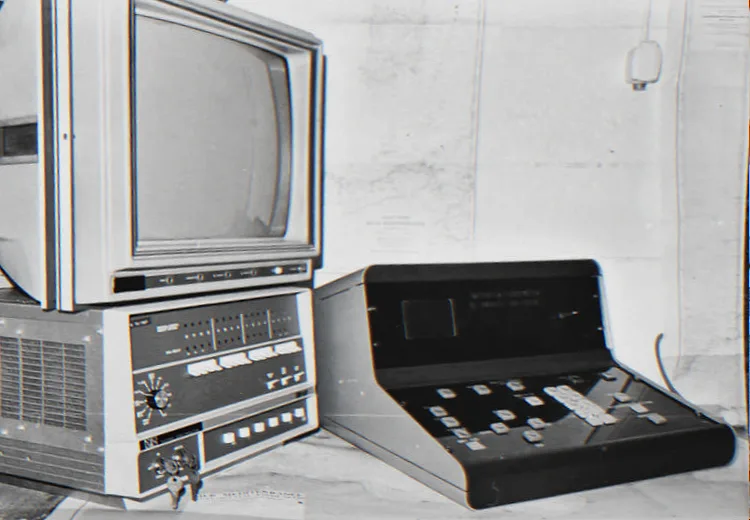
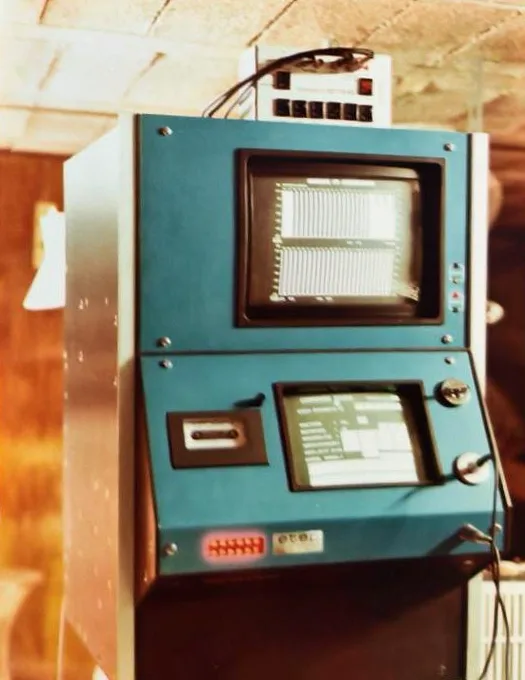
- Acquisition units for hydrophones, the microphones of the underwater world, used for measurements at sea: the hydrophones of an array — 45 on one of them — acquired together, the level of each watched on screen, then conditioned and recorded without a gap.
- Sonar equipment: recording, signal processing and conditioning, the trade at the heart of everything ETEP has built since.
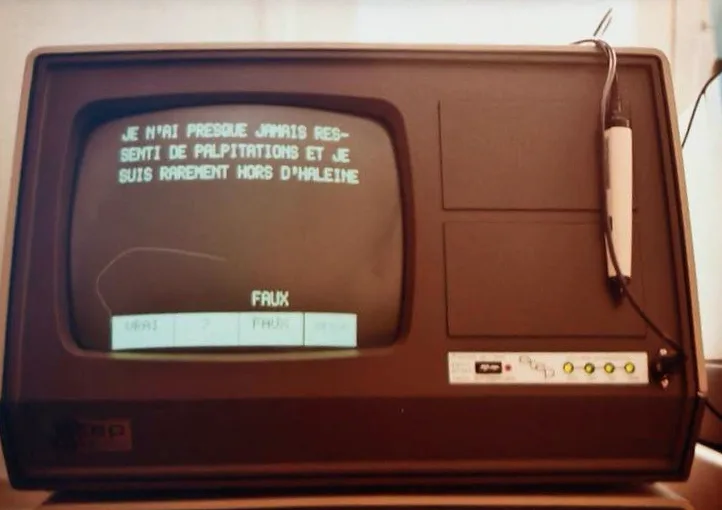
- Computerised psychotechnical test benches, used by the French Navy to select its personnel: the questions on screen, the answers recorded by the machine.
Hydrophone and sonar signals are weak, noisy and continuous, and they are worth something only if they are recorded whole. That was the school ETEP grew up in: clean amplifiers, careful conditioning and nothing lost between the sensor and the recording.
In those years ETEP built a great many acquisition chains, from the sensor to the recording, each delivered with dedicated software written in house for its task. Hardware and software designed together, by the same team: the habit has never left.
A second field: the human body
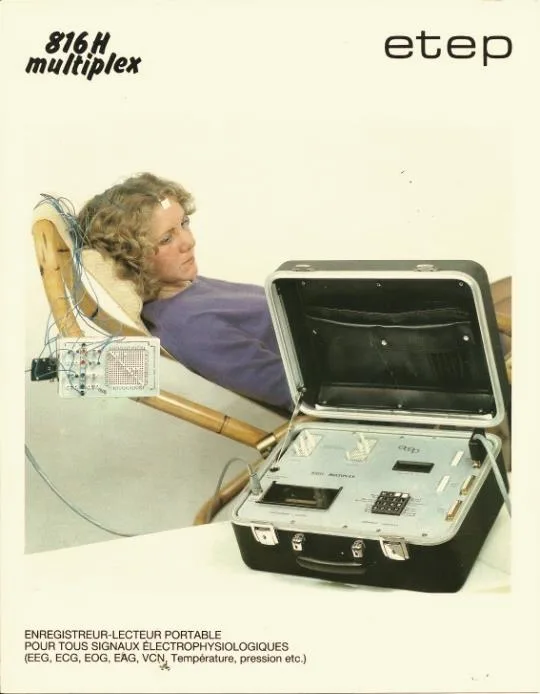
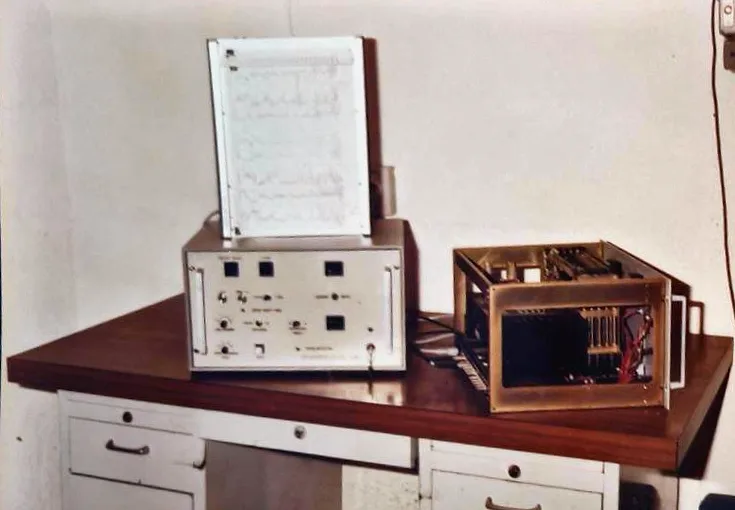
In parallel, ETEP applied the same electronics to physiological measurement. The signals of the human body are, like those of a hydrophone, small and noisy — a few microvolts at the scalp — and they are recorded on a person who moves and must not be disturbed. Ambulatory recorders, worn by the person, kept hours of signals while life went on, and acquisition systems digitised muscle and brain activity, EMG and EEG, for research laboratories, health services and aeronautical medicine. The first portable devices went into production in 1980.
In 1982 came the 816H Multiplex, a portable recorder-player for every electrophysiological signal — EEG, ECG, EOG, temperature, pressure — and one of the first portable recorders to multiplex its channels onto a single tape. Several channels, one tape, one time base: the idea behind the D.T.MUX name was already there.
From the sea to the air
What ETEP had learned — record faithfully, for a long time, in a box that is carried, shaken and dropped, far from any operator — turned out to be exactly what an embedded test recorder needs. In the 1990s it built recorders integrated into sonar and radar systems, and its first autonomous embedded recorder recorded the trials of an underwater test vehicle: no operator on board, no second chance, a recorder that had to start on its own, survive the shocks and bring every channel back.
Then a flight-test centre asked for a recorder. The answer was the same know-how, adapted to an aircraft: the principle of the 816H, many channels multiplexed onto one tape on one time base, now in flight. The format it wrote was called D.T.MUX, for Data Tape Multiplexed, and ETEP's products still carry the name.
What came next
scroll
| Year | Milestone |
|---|---|
| 1979 | ETEP is founded by Jean-Patrick Caille; first equipment for the French Navy |
| 1980 | First portable physiological recorders in production |
| 1982 | 816H Multiplex: a portable recorder multiplexing its channels onto one tape; move into larger, purpose-suited premises |
| 1990s | Recorders integrated into sonar and radar systems; first embedded recorders: an underwater test vehicle, then flight test |
| 1997 | Recorders for tracking Ariane flights at the CNES and ESA telemetry stations |
| 2005 | ISO 9001 certification, maintained ever since |
| 2006 | ETEP moves from Toulon to Cuers |
| 2008 | Launch of the Sentinel crash-protected flight recorder |
| 2018 | Release of the D.T.MUX NanoX modular acquisition platform |
| 2020 | A complete environmental test laboratory installed in house |
| 2023 | EN 9100 aerospace certification |
| 2025 | First ETEP equipment operating in space |
What the early years left behind
- Everything designed in house. Electronics, programmable logic, software and mechanics are still developed under one roof, as they had to be when no supplier made what a hydrophone acquisition unit or a body-worn recorder needed, and every acquisition chain came with its own software. LAB D.T.MUX and D.T.MUX Viewer are the descendants of those programs.
- Measuring right. The signals of a hydrophone or an electrode are faint, and that teaches humility: an amplifier, a filter or a time base is trusted only once it has been checked. The same rigour now applies to strain gauges, avionics buses and video.
- Small, autonomous, robust. Equipment built for the sea and for the human body gave the embedded recorder its culture: every gram, every milliwatt and every connector counts.
- The D.T.MUX format. Born from multiplexing on tape, it still organises the data of ETEP recorders, and converts without loss to IRIG 106 Chapter 10.
In memory of our founder, Jean-Patrick Caille
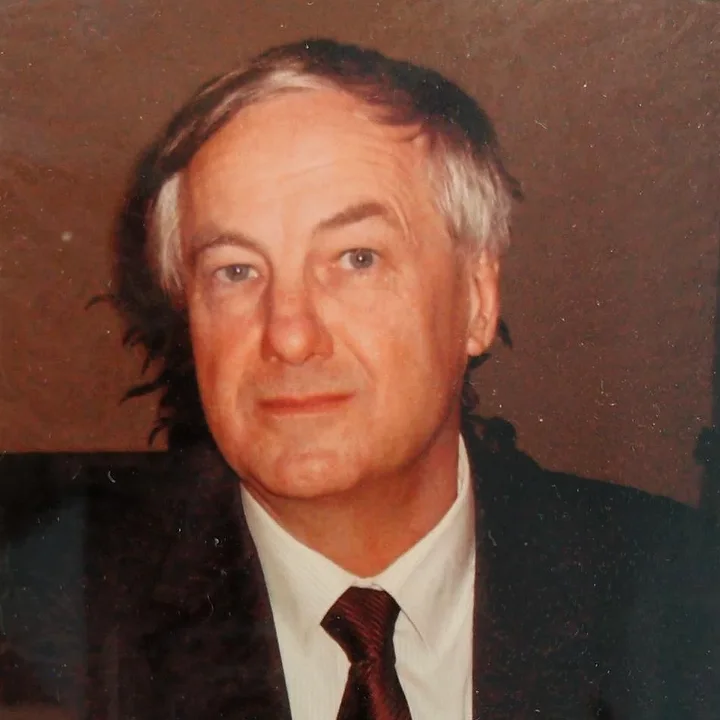
Despite his passing in 2014, ETEP carries on his work, as it has for more than four decades: instruments that record faithfully what nobody can measure twice. This article is dedicated to him.